
Trigger Warning: This post contains discussions of domestic abuse, emotional and psychological abuse, coercive control, manipulation, intimidation, physical abuse and the impact abuse can have on your mental health. Some parts may be difficult to read, particularly for anyone with personal experience of abuse. Please read at your own pace and take a break if you need to.
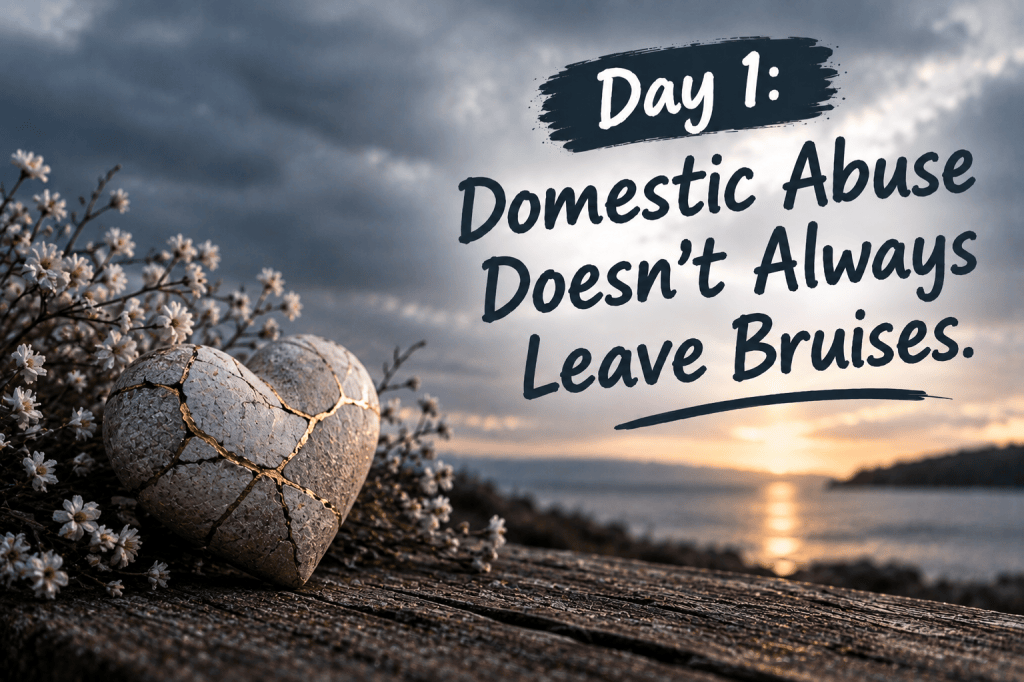
When people hear the words domestic abuse, they usually picture physical violence. They imagine bruises, injuries and something obvious that everyone around the person should be able to see. I have to be honest those used to be the first thoughts I had when I thought about domestic abuse too. I think they are often the signs people look for and the ones we are most aware of, but when abuse doesn’t look like what people expect, there is a much greater chance of it going unnoticed and people suffering in silence. When there are no visible signs, abuse can be incredibly difficult to recognise from the outside. Someone can be experiencing abuse while appearing happy. They can go to work, see friends, smile, laugh and carry on with their everyday life. Someone can be struggling privately while nobody around them knows. I think that’s one of the hardest things about recognising abuse. As I mentioned in my post yesterday, you can become very good at wearing a mask. You get up, put it on, show up for your day and pretend everything is okay. Then you go home, take it off, often cry yourself to sleep, and wake up the next day to do it all over again. It becomes a cycle. Sometimes the person experiencing the abuse doesn’t recognise it straight away either, because abuse doesn’t always begin in a way that feels obviously wrong.
Before this happened to me, I thought domestic abuse was about violence and control. When I thought about control, I imagined the things people often talk about. Someone deciding what another person could wear, who they could see or where they could go. I thought I would know if someone was being abused because of things I had seen or witnessed outside of my own story. I won’t talk about those situations because they are not mine to tell, but they shaped the way I understood what abuse looked like at the time. As I have mentioned before, I never imagined that abuse could look like so many other things until I experienced it myself. That is why I am not saying people should have known. I didn’t know either. The hardest thing to accept now is thinking about how many other people may be going through similar experiences and not realising that what they are experiencing is abuse. Abuse doesn’t always start in a way that feels obviously wrong. Sometimes things happen gradually. Sometimes behaviours become normal because they happen little by little, until you no longer recognise how much things have changed. Towards the end of my relationship, there were moments where other people did start to witness things. The reality is, I was also still trying to understand what was happening myself. I was still in denial, still trying to make sense of something that had become my normal. The person experiencing abuse can be one of the last people to realise how serious it has become.
Sometimes the most damaging things are the things nobody else can see. Abuse can look like someone making you feel isolated, making you believe you have nobody else, or slowly convincing you that they are the only person who will ever understand you. Emotional abuse can change the way someone sees themselves. It can take the qualities that make someone who they are and slowly twist them into something negative. Things that were once strengths can become things they are criticised for. Psychological abuse can make someone question themselves so much that they start to believe they are the problem. They can begin to question their own feelings, their own memories and whether they are overreacting. Abuse can also be financial. It can look like someone controlling money, restricting access to it or making someone feel dependent on them. Abuse can sound like, “You can’t do anything right.” “Why are you making me react this way?” “How dare you speak to me like that?” It can feel like having to tiptoe around someone because you are constantly worried that one wrong word, one wrong action or one small mistake will make them angry. It can feel like your life is no longer your own. Like your choices, your freedom and your confidence are slowly being taken away, and often, these things happen gradually. That is part of what makes abuse so difficult to recognise. Looking back now, I can see that these were not isolated moments. They were patterns of behaviour that affected how I saw myself and how I lived my life.
I know all of this because I lived it. I started questioning myself daily. Over time, I began to hate parts of myself because I couldn’t understand why I could never seem to get things right. I constantly felt like I was failing and that I was the reason things were going wrong. Anxiety is something I have struggled with for as long as I can remember, but towards the end of this relationship it became the worst it had ever been. I was told that my anxiety wasn’t real, that it was something I had made up, and that my panic attacks were just for attention. In the final year, I was also dealing with something else in my life which, combined with the relationship I was in, led to me experiencing depression. This resulted in me going to counselling and eventually to being prescribed antidepressants. Instead of being supported through that, counselling became something else that was used against me. I was told that it wasn’t working because I was too messed up to fix. I was repeatedly told that I was mental, that I was a psycho, that I belonged in a mental hospital and that I needed serious help. Those words had a huge impact on how I saw myself. I started believing them. I felt like I was the problem. Even though a doctor had told me I had anxiety and depression, I started to believe that maybe they were wrong and that there really was something wrong with me. Looking back now, I can see how much those words affected me. At the time, I wasn’t recognising what was happening. I was trying to understand whether there really was something wrong with me.
One of the things that stayed with me for a long time was being told that I deserved it and that “no one has ever made me this way before apart from you.” He would also tell me how disappointed someone in his family, who he looked up to, would be in him because of the way he behaved, and that this was because of me. That made me feel like his behaviour was my responsibility. I started to believe that I must have been a horrible person if I could make someone become that angry towards me. I felt responsible for his reactions and for keeping the peace. I tried so hard to prevent those reactions. I tried to pay attention to the signs, to work out what might make him switch, and to change my own behaviour to avoid conflict, but it became an impossible task. I could never predict what would happen or what would cause a reaction, because the responsibility was never actually mine to carry. I spent so much time trying to understand what I was doing wrong, rather than recognising that I was being blamed for someone else’s choices.
In many ways, I learnt how to act. I tried to mask so much of what I was feeling. I became quieter because I felt like if I didn’t say much, then I couldn’t say anything wrong that might cause a reaction. During arguments, I learnt to stay silent out of fear. Eventually, even that became an issue, but by that point I wasn’t trying to win an argument or prove a point. I just wanted it to stop. I felt like I had to constantly watch what I said. I would think about things before I said them, replay conversations in my head and monitor myself, trying to minimise anything I could possibly do or say that might cause a reaction. I had to put on an act of being happy when, inside, I was shattered. From the outside, I could look completely fine. I could smile, go about my day and pretend everything was normal, but inside, I was slowly disappearing. I gave up a lot of myself. I lost confidence. I lost parts of who I was. I became a shell of myself and felt completely lost because, at that point, I felt hopeless. Looking back now, I realise how much of my life had become about managing someone else’s behaviour rather than simply being myself.
For context, my relationship lasted a total of two years. For the first four months, everything was mostly fine. Then things started to change. Apparently, I had looked at another guy or laughed at something I shouldn’t have. Small things that, at the time, I didn’t realise would become the beginning of something much bigger. By the time things became physical, the abuse had already taken so much from me. The fear, the control and the constant questioning of myself had already become part of my everyday life. I wish someone had recognised the fear on my face when I received a text at work and instantly knew I was in trouble. I knew what was waiting for me when I got home. I wish someone had asked why I had gone from doing well at work to suddenly having a backlog of orders. I did this because it meant that overtime would be available and that meant less time at home. It wasn’t because I was struggling with the work. It was because I had started to give up on everything and work became my safe place. My confidence had gone. My motivation had gone. I was mentally exhausted from constantly trying to manage what was happening in my relationship, and it was starting to affect every part of my life. This is why abuse isn’t always easy to see. You might not look bruised on the outside, but you can be deeply hurt on the inside. By the time the physical abuse started, I had already been living with abuse for a long time.
From the outside, people may have thought that I was happy. That we were happy. He was very bothered about the image we portrayed to other people. There were not many times outside of work when I was allowed to go out without him. There were the occasional few times I was allowed out for a bit with my mum, but even then, it was timed. I became very good at appearing happy in front of my family. What they didn’t see was the car parked a few roads away from their houses, where he had had a go at me on the journey there, and because I was still upset when we arrived, he would give me a talk about how I needed to stop being upset and be happy in front of everyone. I needed to put the mask back on. This became a regular thing when we went to family occasions at Christmas, days out with my family or the few times we went out with my friends. I knew things had got bad when I started carrying makeup in my bag so that I could fix my face in the car and try to hide where I had cried it off. People saw me smiling.
They saw us together. They saw what we allowed them to see. What they didn’t see was what had happened minutes before, or what I was feeling underneath it all. I could be surrounded by people I loved and still feel completely alone. That is one of the hardest things to explain about abuse. You can be in a room full of people, surrounded by people who care about you, and still feel like nobody knows what is really happening. From the outside, I looked like I was there. Inside, I was somewhere completely different.
If you take one thing away from this post, I hope it is this: sometimes the people closest to us are the ones who notice the smallest changes. If you notice someone’s mood or behaviour changing, or you simply get the feeling that something isn’t quite right, please try to talk to them. Just ask if they’re okay. Please don’t wait until you see more obvious signs to ask. Someone doesn’t have to have bruises for something serious to be happening, and even if they don’t open up to you, knowing that someone has noticed, that someone cares and that they are seen, can mean more than you realise. I don’t blame a single person for not noticing what happened to me. After all, I was trying to cover it up too. At the time, I didn’t feel like I had much choice. The mask did slip a few times, though. Even when what I was saying was convincing, I sometimes felt like my face was telling a different story. Looking back, I wonder whether someone asking me a simple question like, “Are you okay?” might have made a difference. Maybe I wouldn’t have been ready to answer. Maybe I would have said I was fine, but sometimes, just knowing that someone has noticed can be the beginning of feeling less alone. You don’t need to have the right words. You don’t need to know exactly what is happening. Just check in. Ask. If they aren’t ready to talk, let them know that you’re there when they are.
Domestic abuse is not only about what someone does. It is also about the control they gain, the fear they create and the way someone slowly loses parts of themselves. Tomorrow, I will talk about something that is often mistaken for love: control.
🧡 Support and Resources
If you or someone you know is experiencing domestic abuse, support is available.
National Domestic Abuse Helpline (UK)
📞 0808 2000 247
🌐 Refuge National Domestic Abuse Helpline
🌐 Women’s Aid
🌐 Men’s Advice Line
Amy x

