

Trigger Warning: This post discusses domestic abuse, controlling behaviour, emotional abuse, isolation and manipulation. Some content may be difficult to read, particularly for anyone with personal experience of abuse.
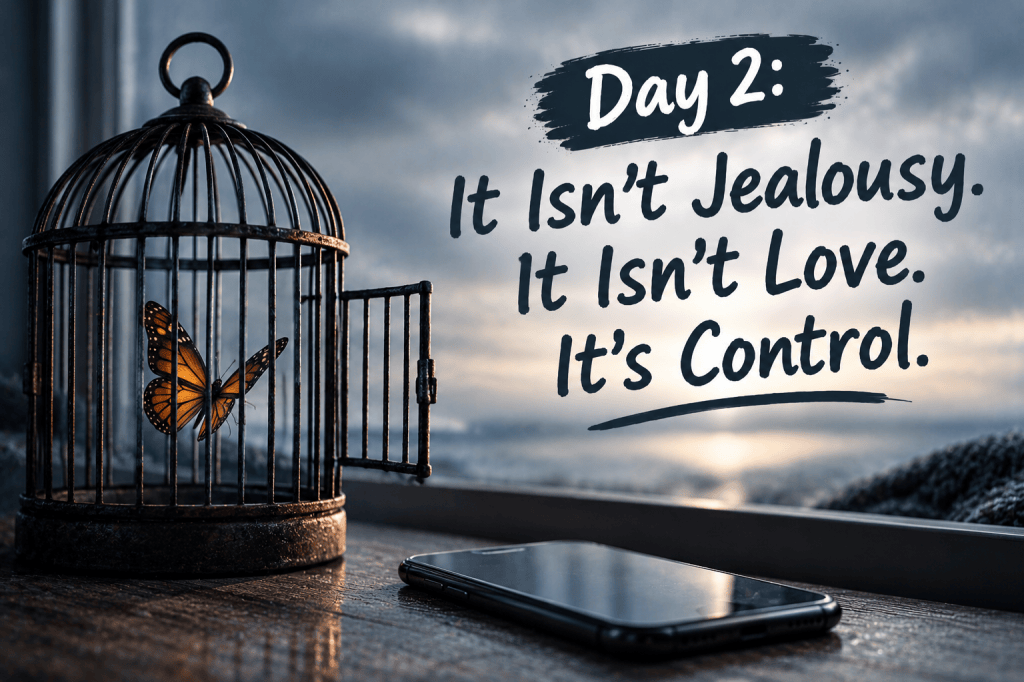
I think one of the reasons control can be so difficult to recognise is because some controlling behaviours can initially look like jealousy. Jealousy is often romanticised. I think a lot of us grow up believing that if our partner is jealous, it means they care because they don’t like the idea of losing us or being replaceable. I used to think normal jealousy in a relationship looked like your partner being bothered when you talked about a celebrity crush, or perhaps making a comment because they didn’t like the idea of you finding someone else attractive. We see jealousy portrayed as romantic in films and on television, where possessiveness is often presented as proof of how much someone loves or wants another person, but there is a difference between feeling jealous and using that jealousy to control someone. Someone can say, “I’m feeling insecure,” and have an honest conversation about why they feel that way. That is very different from using those feelings as a reason to question who you speak to, where you look, what you wear, where you go or what you do. Jealousy can stop being just a feeling and become a behaviour when it turns into monitoring, accusations and control over your everyday life, and I think that distinction is really important, because control doesn’t always start with someone telling you what you can and can’t do. Sometimes it starts with something that looks like jealousy.
For me, it started with being accused of looking at another guy in the street. I was so confused because I was just looking at him in the same way I would look at anyone else, but apparently, I was checking him out. Then there was the time I laughed at something I found funny, and it happened to be a guy who had made the joke. What I thought was completely innocent, or wasn’t even aware was an issue, suddenly became something I had to think about. I started having to think about where I looked, what I said and how I behaved. I remember one time he showed me a picture of a friend of his that we were talking about. Apparently, I gave a certain look that meant I fancied him. He wasn’t happy with me. We were out at a pub at the time, and I remember thinking that if we hadn’t been there, I believe his reaction could have been very different. Instead, he didn’t speak to me for the rest of the night. At the time, I didn’t necessarily think about this as control. I just thought I needed to be more careful. I started learning what might make him unhappy and tried to make sure I didn’t do those things again, but that was the problem. His reactions made me feel like I needed to monitor myself. I wasn’t just thinking about what I wanted to say or do anymore. I was thinking about how he might interpret it, whether it might make him angry and what I could do to prevent another reaction. His jealousy was becoming something that controlled my behaviour.
Controlling behaviour doesn’t always sound aggressive. It can sound like:
“Where are you?”
“Who are you with?”
“Why haven’t you replied?”
“Why did you take so long?”
“Why didn’t you tell me?”
On their own, some of these questions might not seem unreasonable. Partners can ask where each other are or what they’re doing. The difference is how often it happens, what happens when you don’t respond and how it makes you feel. I remember one time when my mum and I decided to start Couch to 5K. Anyone who has done it will know that a session takes roughly half an hour. I was walking home afterwards and had multiple texts and phone calls waiting for me. The messages were telling me that I had been out for too long. There was another time when I was with another family member. He knew I was busy, yet over the course of three hours I had close to 80 text messages. Then there were the messages I would get if I was late taking my break at work. There was nothing I could do about when my break was sometimes, but I would still receive messages asking why I was late and questioning what I was doing. He wasn’t always satisfied with the reason. I started watching the clock because I knew my phone would start blowing up if I was late. Even when I was allowed to go out with family without him, I felt like I had to keep checking my phone to make sure I wasn’t missing anything. I wasn’t checking it because I wanted to. I was checking it because I was worried about what would happen if I didn’t. That is the difference between communication and control. It wasn’t simply that he wanted to know where I was. I had started to feel like I needed to account for my time, my whereabouts and how quickly I responded at all times. Eventually, even when he wasn’t there, I was still monitoring myself because I was anticipating his reaction.
There were multiple times when I wanted to ring my mum or my nan because I was scared and had got myself into such a state. As soon as I got my phone out, though, he would grab it out of my hand. I don’t know exactly why he did that. What I do know is how it made me feel. It made me feel so hopeless. In those moments, my phone wasn’t just a phone. It was my way of reaching someone I trusted. It was my connection to the people who could have supported me when I was scared. When he took it away, it felt like any lifeline I had was gone. It felt like I had lost access to my own support system at the exact moment I needed it most. Looking back, I can see how significant that was. It wasn’t just about taking my phone. It meant taking away my ability to reach out for help and making me feel even more alone. A healthy relationship shouldn’t require you to surrender your privacy, your communication or your access to the people who support you. You should never feel like reaching out to your family is something you need permission to do.
He didn’t necessarily stop me from seeing my friends and family in the way you might normally expect isolation to look. Isolation doesn’t always mean, “You’re not allowed out.” I was allowed to see my family and I was allowed to see one of my friends and her partner. The difference was that he usually had to be there too. I didn’t see my best friend very often, but when we did go out with her and her partner, things were generally fine. It was never just me and her. It was when we went to family occasions that things became more difficult. I wasn’t allowed to have a joke with him without it potentially becoming a problem. If he felt that I had embarrassed him in some way, I knew there would be consequences afterwards. I remember being screamed at in the car on the journey home because of something that had happened while we were with my family. So, technically, I was still seeing people, but I wasn’t experiencing those occasions in the same way other people were. I was constantly thinking about what I said, how I behaved and whether something I did might cause a reaction later, and if I’m completely honest, seeing friends and family eventually became difficult for another reason too.
It was getting harder to appear happy when, inside, I couldn’t stand being around him. I didn’t want to be seen associated with him, and I was exhausted from having to pretend that everything was okay. So I started avoiding as much interaction with other people as I could. Not because I didn’t want to see them, because pretending became exhausting. That is another way isolation can happen. Sometimes nobody has to tell you that you can’t see people. Sometimes the fear of what will happen afterwards, the pressure of having to pretend and the exhaustion of constantly managing someone else’s behaviour can make you withdraw yourself.
Control can also come in the form of finances. I didn’t have money physically withheld from me, but by the end of the relationship I was around £2,000 out of pocket. It started when he was off work with a bad back and couldn’t afford his share of the bills and rent. At first, I didn’t have a problem helping because I understood that sometimes things happen and people need support, but he was still taking part in a very physical hobby at weekends, which I found difficult to understand when I was taking on more and more of the financial responsibility. I became responsible for almost everything. If we went out for a meal, I would pay for it. He would ask if he could borrow money for fuel, and there were times when that money was spent on betting instead. I also ended up paying for all of his family’s Christmas presents. He would always tell me that he would pay me back. He didn’t. The money continued to add up, but I never felt like I could properly challenge him about it. I felt responsible for keeping everything going, and questioning him about money felt like it could become another problem. Looking back, I can see how much I had taken on. It wasn’t simply about the money I lost. It was about feeling responsible for another adult’s finances while not feeling able to say, “This isn’t okay.” By the time I ended the relationship, I was around £2,000 out of pocket, but when I finally broke things off, getting completely away from him mattered more to me than the money. At that point, I just wanted to be free from the relationship.
Looking back now, I can see that the biggest change wasn’t just what he was controlling. It was how much I started controlling myself. I was constantly thinking about what I said, where I looked, how long I was out, how quickly I replied and whether something I did might cause a reaction. I started watching the clock at work. I checked my phone constantly when I was out. I thought about how I behaved around other people. I became careful about what I said and who I joked with. I was trying to prevent problems before they happened. The thing is, when you spend so much time trying to avoid someone’s reactions, you don’t realise how much of yourself you are giving up in the process. I wasn’t making choices based on what I wanted to do anymore. I was making choices based on what I thought would keep the peace. I had started to monitor myself so much that it became normal. I didn’t wake up one day and decide that I was going to change who I was. It happened gradually, through small decisions and small adjustments, until eventually I didn’t feel like I was being myself anymore. I think that’s one of the things about control that can be so difficult to explain. Someone doesn’t always have to tell you exactly what you can and can’t do. Sometimes, after enough reactions, arguments and consequences, you learn to police yourself, and that’s when you realise just how much control has already taken from you.
Control isn’t love. Jealousy isn’t proof that someone cares about you. Being constantly asked where you are, who you’re with or why you haven’t replied isn’t someone simply being interested in your day. Being monitored isn’t protection. Being made to feel like you have to change the way you behave to keep someone happy isn’t a healthy relationship. I think one of the biggest things I have learnt is that love shouldn’t make you feel like you have to constantly prove that you are trustworthy. You shouldn’t be scared to look somewhere, laugh at something, speak to someone or spend time with your family because you’re worried about how your partner might react. You shouldn’t have to watch the clock because you’re worried about what will happen if you’re late. You shouldn’t have to check your phone constantly because you’re scared of missing a message. You shouldn’t have to make yourself smaller to keep someone else happy. A healthy relationship should allow you to have your own friends, your own family, your own interests and your own identity. You should be able to be yourself without constantly calculating how your partner might react. Looking back, I can see that what I thought was jealousy was actually the beginning of something much bigger. It wasn’t about how much he cared about me. It was about how much control he had over me, and there is a very big difference between the two.
🧡 Support and resources
If you or someone you know is experiencing domestic abuse, support is available.
National Domestic Abuse Helpline (UK)
📞 0808 2000 247
🌐 Refuge National Domestic Abuse Helpline
🌐 Women’s Aid
🌐 Men’s Advice Line
Amy x

